What we want and don't want from the dark forest era
The finale of our season-long exploration of the dark forest
Over the past three months, Josh and I have sat down together to explore the rise of private online communities — what we call dark forests.
We explored these spaces in depth. Everything from their philosophy to economics to their technical stack. The season culminated with us introducing a new space for our community and new infrastructure from Metalabel to help others do the same.
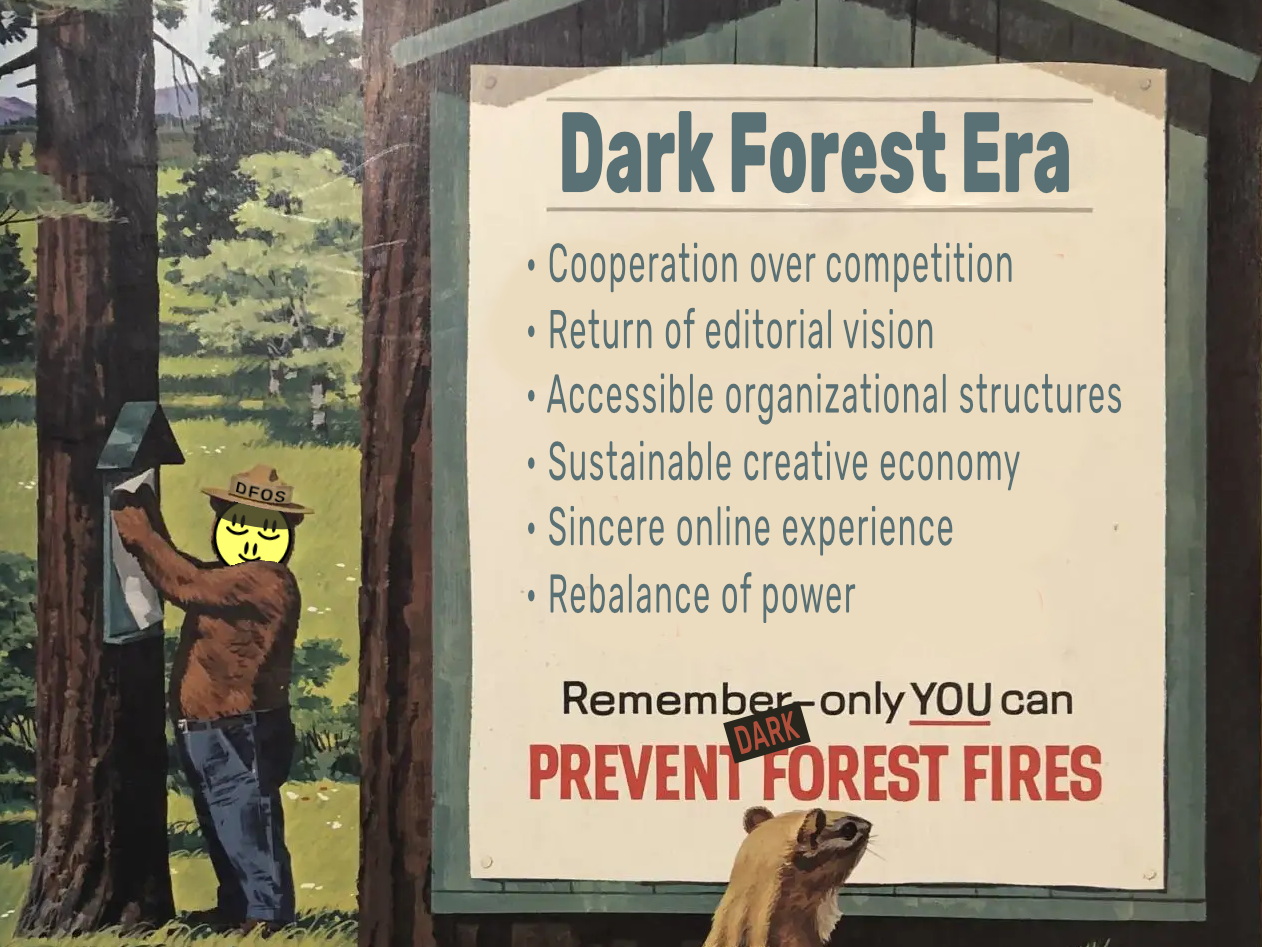
Just as we did last season, we’re closing this one by each making a list of five things we want and don’t want to see in this Dark Forest Era. Though we didn’t share our lists beforehand, they were remarkably aligned.
Listen on Apple, Spotify, or below.
What we want
What do we want to see as the Dark Forest rises? We want:
1. Cooperation over competition as the default
The internet trained us to treat every thought as a bid for attention. Your banger is my loss. But when you share an idea with a friend instead of posting it, something different happens — conversation becomes collaboration becomes a project. Metalabel started this way. The shift from single-player clout-chasing to relational creation will define this era.
2. The return of editorial vision
In an oversaturated landscape, people want quality. Gatekeeping removes value by excluding people arbitrarily. Editorial vision adds value by curating with intention. This is the quality that separates what gets attention from what doesn’t.
3. Accessible organizational structures
There's a huge gap between being a Delaware C-Corp and being a group of people who want to do something together. We want dark forests and A-Corps to lower the barrier to collective action making it possible to organize and produce culture without becoming a "real" company first.
4. A sustainable creative economy that works across disciplines
Every platform is optimized for one thing — your audio here, your writing there, your video somewhere else. We want an ecosystem where interdisciplinary work can thrive, not just survive on $5 subscriptions driven by the inconvenience of piracy.
5. A more sincere online experience
Time spent chatting with peers is fundamentally different from time spent scrolling and performing. In spaces where you're not competing for attention, a different behavior emerges. We think this leads toward a new sincerity — not naive, but post-knowing.
6. A rebalancing of power through community
Dark forest group chats may be the key social structure of the 21st century. This looks like Robert Putnam's dream of civic society in a form no one expected. Not bowling leagues — something new, and potentially a golden age of community.
What We Don't Want
With every light there is a shadow. What don’t we want to see? We don’t want:
1. A million tiny fortresses
We're already here. It's the streaming wars. It's every group behind its own paywall. The unbundling-rebundling cycle can produce a landscape just as fragmented as what we're leaving — except now it's private, too.
2. Country clubs with high barriers to entry
If prices get too high, dark forests become exclusive enclaves. Forkability and competition should put downward pressure, but the risk is real.
3. The culture war on steroids
Stronger in-groups mean stronger out-groups. More cohesion within communities can easily mean more hostility between them.
4. A rentier class extracting value
Imagine a dark forest run by a distant landlord — someone who built the space, captured the community, then stopped caring while collecting dues. We don't want that logic replicated in community spaces.
5, Network states replacing public institutions
There's an important line between private spaces for culture — great — and the fantasy of replacing public goods with private governance. The people pushing hardest for that see the nation-state as the last limit on their power.
6. The same extractive pattern repeating itself
History rhymes. Things start idealistic and become extractive. The ladder gets pulled up. APIs get shut down. The founder gets replaced by the MBA. It's the most likely outcome, which is exactly why it has to be designed against — with data portability, decentralized identifiers, and infrastructure built deep enough that it can't be ripped out later. If we're going to be post-naive about anything, it should be this.
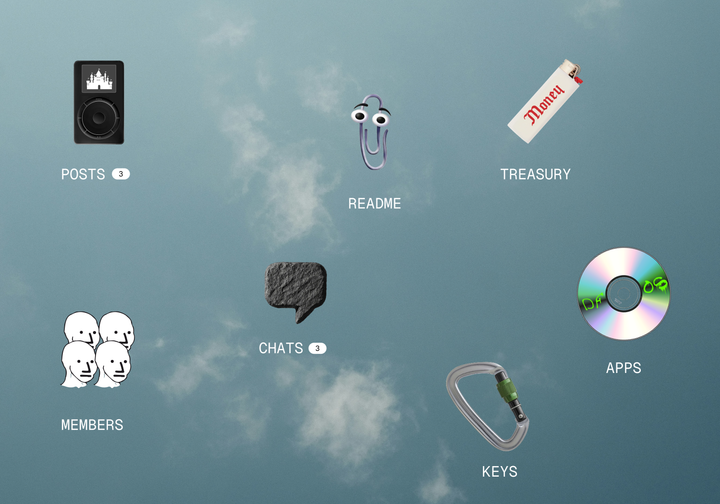
What are your hopes and fears? Talk about them in the NCE DFOS.
Comments ()